Huanmi Tan
谭欢秘, pronounced as /'hwɑnmi tæn/

I am a software engineer at AWS, on the Web Intelligence team within the Agentic AI organization. We build local and remote web browsing agents that perceive and act on live web interfaces to carry out real user tasks, along with the tooling and MCP integrations that connect them to external systems.

I received my Master's degree in Software Engineering from SCS of Carnegie Mellon University, and my Bachelor's degree in Software Engineering from Tongji University. During my Bachelor's, I interned at Shanghai AI Lab and ByteDance AI Lab.

My work sits between language models and the systems they act on. Current interests:

  • LLM agents: web agents, browser automation, tool use and MCP
  • Evaluation: automated benchmark construction and failure analysis
  • Code generation: correctness, execution feedback, and optimization
  • Reasoning: logical and constraint-based problem solving in LLMs

Building agents in production offers a vantage point that is hard to reach from benchmarks alone: real websites change, break, and fail in ways that frozen evaluation environments never surface. I am always glad to talk about agent evaluation, and I am open to collaboration.


Education
  • Carnegie Mellon University
    Carnegie Mellon University
    Master's in Software Engineering
    Aug. 2023 - Dec. 2024
  • Tongji University
    Tongji University
    B.E. in Software Engineering
    Sep. 2019 - Jul. 2023
  • North Carolina State University
    North Carolina State University
    GEARS Research Program
    Jun. 2022 - Aug. 2022
Experience
  • Amazon Web Services
    Amazon Web Services
    SDE | Web Intelligence, Amazon Quick
    Jun. 2025 - Present
  • ByteDance AI Lab
    ByteDance AI Lab
    Intern | Volcano Machine Translation, AI Lab
    Mar. 2023 - Aug. 2023
  • Shanghai AI Lab
    Shanghai AI Lab
    Research Intern | AI for Imaging Group
    Nov. 2022 - Feb. 2023
News
2026
One of our papers got accepted to COLM 2026!
Jul 08
I got 80+ citations 🎉
Jul 01
2025
I proudly became a cat lady! Introducing my baby girl, Juzai.
Sep 24
One of our papers got accepted to EMNLP main. See you in Suzhou, China!
Aug 20
I started a full time position at AWS!
Jun 09
2024
I received my Master's degree from CMU!
Dec 18
Selected Publications (view all )
VeriCoder: Enhancing LLM-Based RTL Code Generation through Functional Correctness Validation

Anjiang Wei, Huanmi Tan, Tarun Suresh, Daniel Mendoza, Thiago SFX Teixeira, Ke Wang, Caroline Trippel, Alex Aiken

NuerIPS 2025 Fourth Workshop on Deep Learning for Code 2025

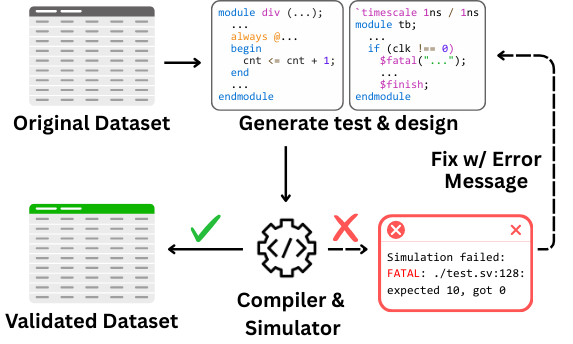
VeriCoder is a model for RTL (Register Transfer Level) code generation, fine-tuned on a novel dataset that is functionally validated via feedback-directed refinement. Unlike prior datasets that only ensure syntactic correctness, our dataset guarantees that each RTL design passes automatically generated unit tests aligned with its natural language specification. Our key contributions include: (1) a large-scale dataset of 125,000+ examples with simulation-passing RTL designs, (2) a feedback-driven construction methodology that iteratively refines designs and tests based on test results, (3) superior performance with up to +71.7% relative improvement on VerilogEval benchmarks, and (4) comprehensive resources including dataset, model weights, inference scripts, and training pipeline.

VeriCoder: Enhancing LLM-Based RTL Code Generation through Functional Correctness Validation

Anjiang Wei, Huanmi Tan, Tarun Suresh, Daniel Mendoza, Thiago SFX Teixeira, Ke Wang, Caroline Trippel, Alex Aiken

NuerIPS 2025 Fourth Workshop on Deep Learning for Code 2025

VeriCoder is a model for RTL (Register Transfer Level) code generation, fine-tuned on a novel dataset that is functionally validated via feedback-directed refinement. Unlike prior datasets that only ensure syntactic correctness, our dataset guarantees that each RTL design passes automatically generated unit tests aligned with its natural language specification. Our key contributions include: (1) a large-scale dataset of 125,000+ examples with simulation-passing RTL designs, (2) a feedback-driven construction methodology that iteratively refines designs and tests based on test results, (3) superior performance with up to +71.7% relative improvement on VerilogEval benchmarks, and (4) comprehensive resources including dataset, model weights, inference scripts, and training pipeline.

SATBench: Benchmarking LLMs’ Logical Reasoning via Automated Puzzle Generation from SAT Formulas

Anjiang Wei, Yuheng Wu, Yingjia Wan, Tarun Suresh, Huanmi Tan, Zhanke Zhou, Sanmi Koyejo, Ke Wang, Alex Aiken

EMNLP Main 2025

We introduce SATBench, a benchmark for evaluating the logical reasoning capabilities of large language models (LLMs) through logical puzzles derived from Boolean satisfiability (SAT) problems. Unlike prior work that focuses on inference rule-based reasoning, which often involves deducing conclusions from a set of premises, our approach leverages the search-based nature of SAT problems, where the objective is to find a solution that fulfills a specified set of logical constraints. Each instance in SATBench is generated from a SAT formula, then translated into a story context and conditions using LLMs. The generation process is fully automated and allows for adjustable difficulty by varying the number of clauses. All 2100 puzzles are validated through both LLM-assisted and solver-based consistency checks, with human validation on a subset. Experimental results show that even the strongest model, o4-mini, achieves only 65.0% accuracy on hard UNSAT problems, close to the random baseline of 50%. SATBench exposes fundamental limitations in the search-based logical reasoning abilities of current LLMs and provides a scalable testbed for future research in logical reasoning.

SATBench: Benchmarking LLMs’ Logical Reasoning via Automated Puzzle Generation from SAT Formulas

Anjiang Wei, Yuheng Wu, Yingjia Wan, Tarun Suresh, Huanmi Tan, Zhanke Zhou, Sanmi Koyejo, Ke Wang, Alex Aiken

EMNLP Main 2025

We introduce SATBench, a benchmark for evaluating the logical reasoning capabilities of large language models (LLMs) through logical puzzles derived from Boolean satisfiability (SAT) problems. Unlike prior work that focuses on inference rule-based reasoning, which often involves deducing conclusions from a set of premises, our approach leverages the search-based nature of SAT problems, where the objective is to find a solution that fulfills a specified set of logical constraints. Each instance in SATBench is generated from a SAT formula, then translated into a story context and conditions using LLMs. The generation process is fully automated and allows for adjustable difficulty by varying the number of clauses. All 2100 puzzles are validated through both LLM-assisted and solver-based consistency checks, with human validation on a subset. Experimental results show that even the strongest model, o4-mini, achieves only 65.0% accuracy on hard UNSAT problems, close to the random baseline of 50%. SATBench exposes fundamental limitations in the search-based logical reasoning abilities of current LLMs and provides a scalable testbed for future research in logical reasoning.

Improving Assembly Code Performance with Large Language Models via Reinforcement Learning

Anjiang Wei, Tarun Suresh, Huanmi Tan, Yinglun Xu, Gagandeep Singh, Ke Wang, Alex Aiken

NeurIPS 2025 Fourth Workshop on Deep Learning for Code 2025

Large language models (LLMs) have demonstrated strong performance across a wide range of programming tasks, yet their potential for code optimization remains underexplored. This work investigates whether LLMs can optimize the performance of assembly code, where fine-grained control over execution enables improvements that are difficult to express in high-level languages. We present a reinforcement learning framework that trains LLMs using Proximal Policy Optimization (PPO), guided by a reward function that considers both functional correctness, validated through test cases, and execution performance relative to the industry-standard compiler gcc -O3. To support this study, we introduce a benchmark of 8,072 real-world programs. Our model, Qwen2.5-Coder-7B-PPO, achieves 96.0% test pass rates and an average speedup of 1.47x over the gcc -O3 baseline, outperforming all 20 other models evaluated, including Claude-3.7-sonnet. These results indicate that reinforcement learning can unlock the potential of LLMs to serve as effective optimizers for assembly code performance.

Improving Assembly Code Performance with Large Language Models via Reinforcement Learning

Anjiang Wei, Tarun Suresh, Huanmi Tan, Yinglun Xu, Gagandeep Singh, Ke Wang, Alex Aiken

NeurIPS 2025 Fourth Workshop on Deep Learning for Code 2025

Large language models (LLMs) have demonstrated strong performance across a wide range of programming tasks, yet their potential for code optimization remains underexplored. This work investigates whether LLMs can optimize the performance of assembly code, where fine-grained control over execution enables improvements that are difficult to express in high-level languages. We present a reinforcement learning framework that trains LLMs using Proximal Policy Optimization (PPO), guided by a reward function that considers both functional correctness, validated through test cases, and execution performance relative to the industry-standard compiler gcc -O3. To support this study, we introduce a benchmark of 8,072 real-world programs. Our model, Qwen2.5-Coder-7B-PPO, achieves 96.0% test pass rates and an average speedup of 1.47x over the gcc -O3 baseline, outperforming all 20 other models evaluated, including Claude-3.7-sonnet. These results indicate that reinforcement learning can unlock the potential of LLMs to serve as effective optimizers for assembly code performance.

All publications
Honors & Awards
  • Second Prize of Citi Cup (Fintech Innovation Application Competition)
    2022
  • Academic Excellence Scholarship of Tongji University (Top 10%)
    2022
  • Third Prize in Mobile Application Innovation Competition
    2021
  • First Prize of East China Region in Mobile Application Innovation Competition of CCCC
    2021
  • Academic Excellence Scholarship of Tongji University (Top 10%)
    2021
  • Academic Excellence Scholarship of Tongji University (Top 10%)
    2020
Visitor Map